Simulation system for medical education
You create the patient. Your students treat them.
A patient who talks out loud, is examined in 3D and reacts to every decision. Students practise as much as they need, and the grade stays yours.
A real recording from the system. In Bulgarian, with subtitles. Synthetic face. Example case.
Maria, 47At her GP. Headaches for two weeks.A simulation. The face is synthetic.
Maria
Здравейте, докторе, от две седмици ме боли главата сутрин, в задната част. Притеснена съм, защото вкъщи си премерих кръвното с апарата на мъжа ми и беше 165 на 100.
Hello, doctor. For two weeks I’ve had a headache in the mornings, at the back of my head. I’m worried because I measured my blood pressure at home with my husband’s monitor and it was 165 over 100.
Why
More practice. No risk to a patient.
-
The problem
Students rarely lead a patient alone from the first question to treatment.
-
The answer
A patient they talk to, examine and treat, as often as they need.
-
Who it is for
Medical schools, simulation centres and hospitals with postgraduate training.
Clinical simulation
Not just a conversation. A whole clinical case.
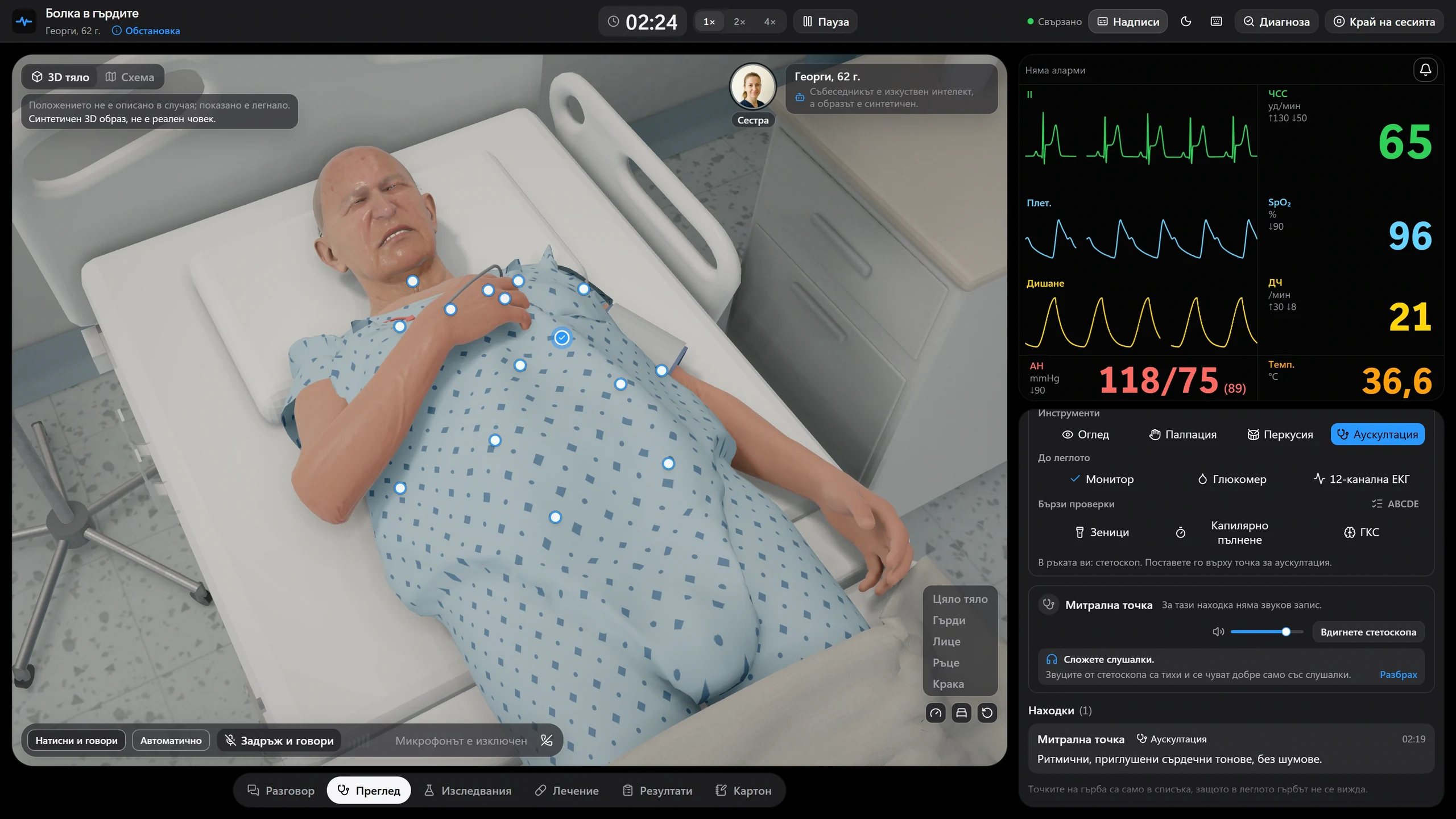
A 3D body in a hospital bed, bedside devices, investigations with real recordings and a monitor that responds to treatment.
-
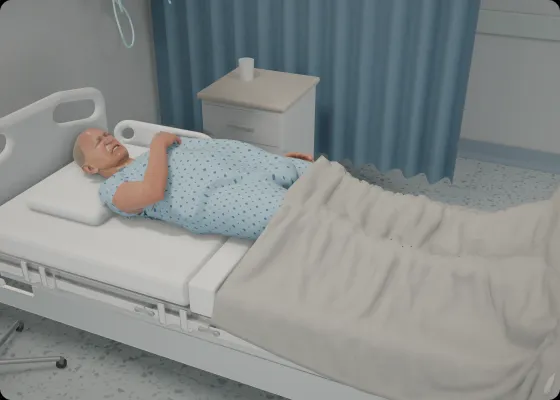
A patient in 3DInspection, palpation and percussion -
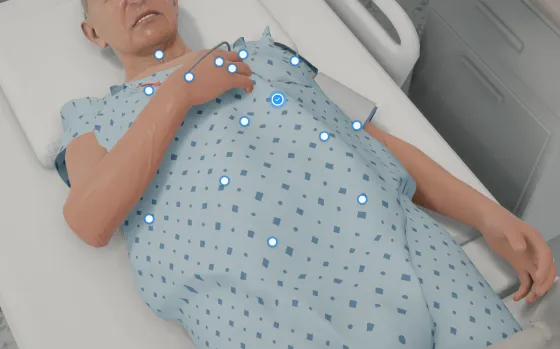
Auscultation22 points, recorded sounds -
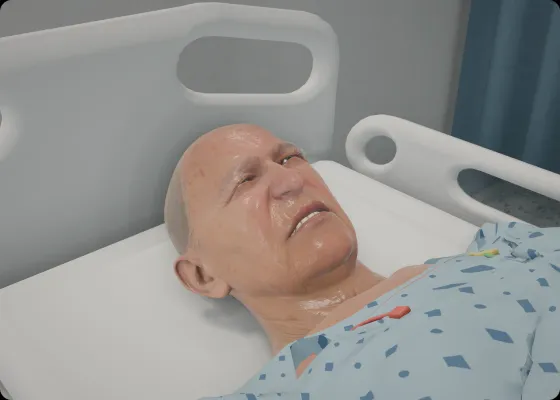
Clinical signsSweat, pallor, rash, oedema -
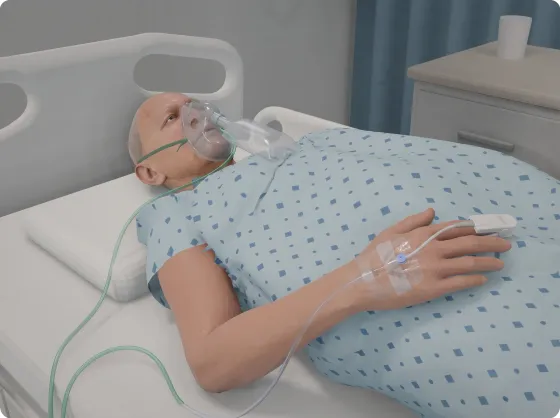
ProceduresOxygen, IV access, infusions -
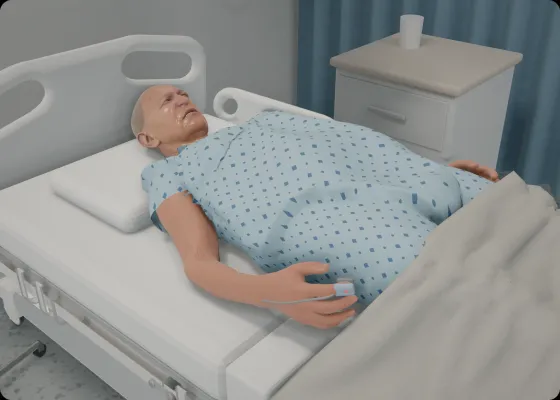
Bedside devicesMonitor, glucometer, ECG -
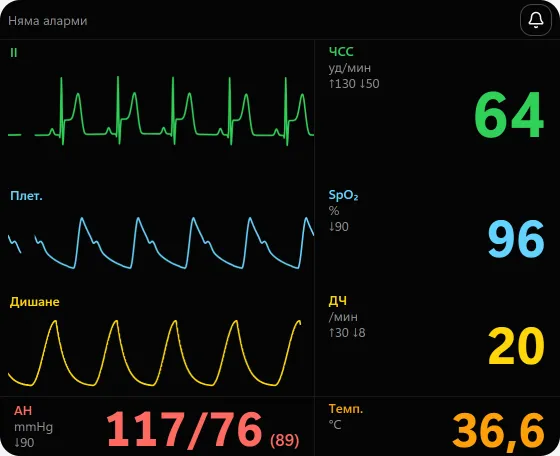
A live monitorVital signs follow the treatment -
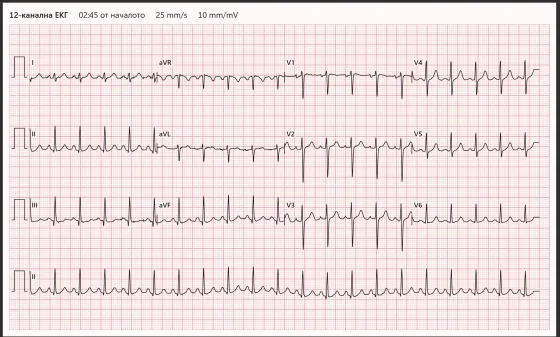
12-lead ECGA real recording on millimetre paper -
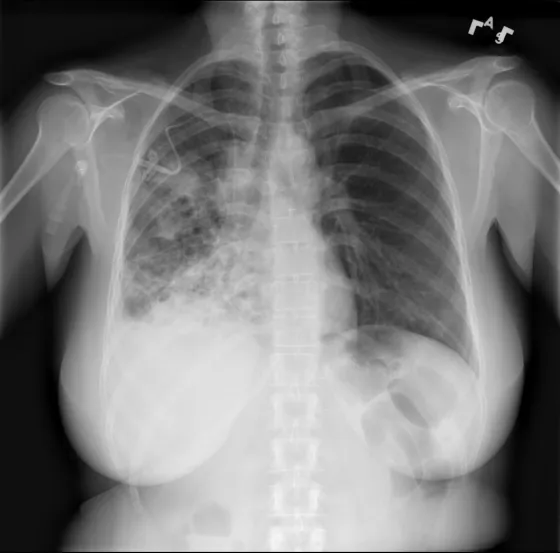
Chest X-rayZoom, brightness, negative
3D frames and screens from the system. The procedures frame is an illustration in its style. Synthetic images; the ECG and the X-ray come from open research datasets.
The patients
Faces your students remember. You write their stories.
Every patient has a face, a voice and a character. What has happened to them is up to you.
-
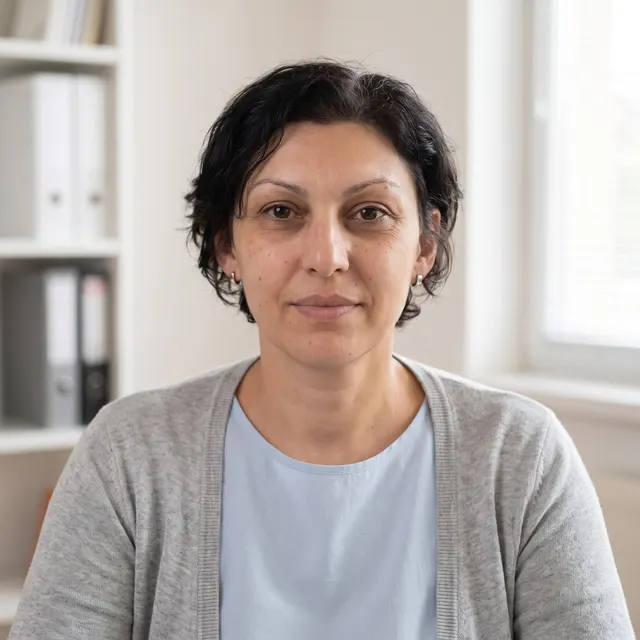 Talks
Talks Maria 47, at the GP -
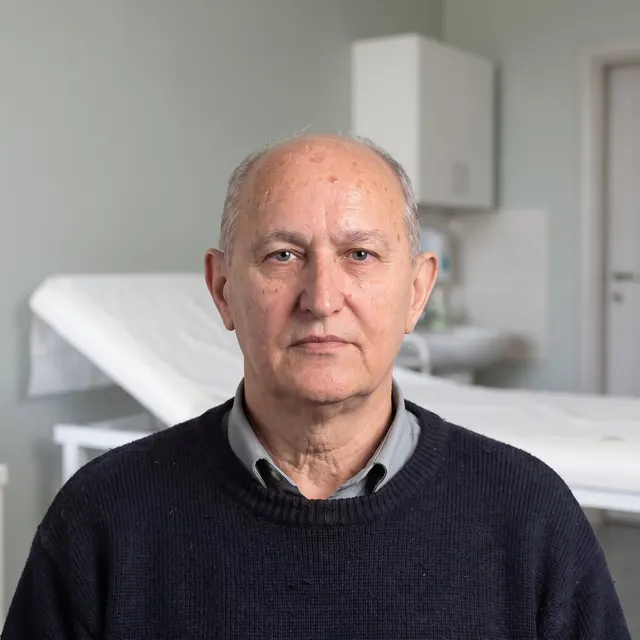
Georgi 62, at the GP’s office -
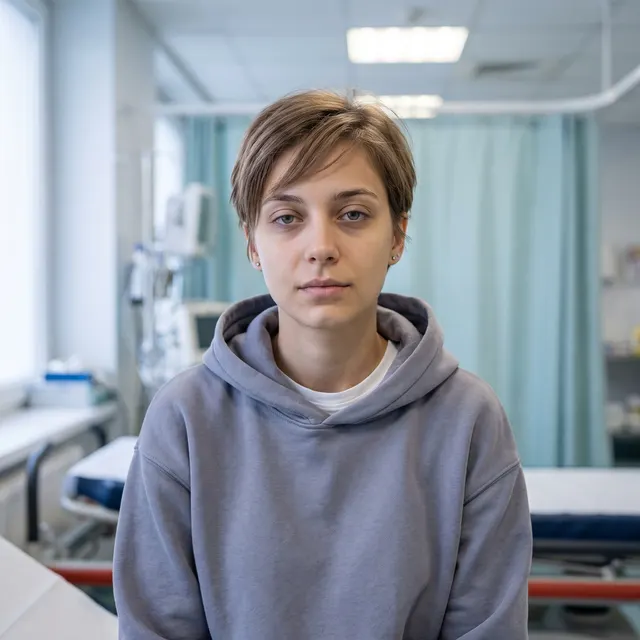
Viktoria 23, in the emergency department -
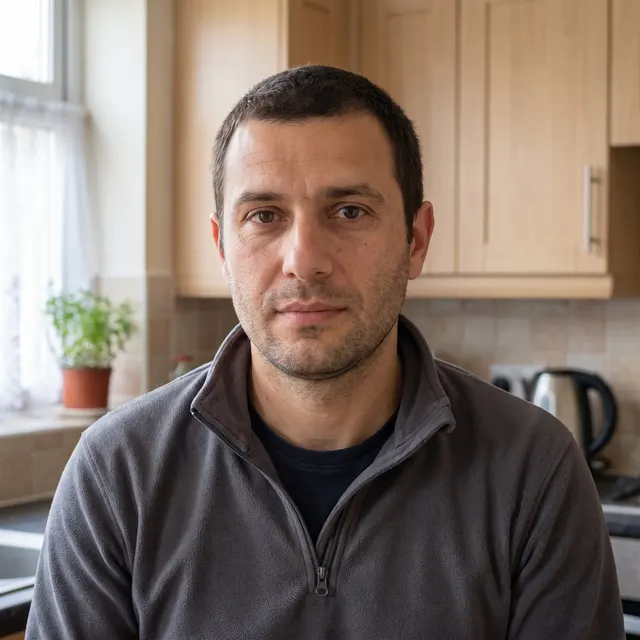
Nikolay 36, at home -
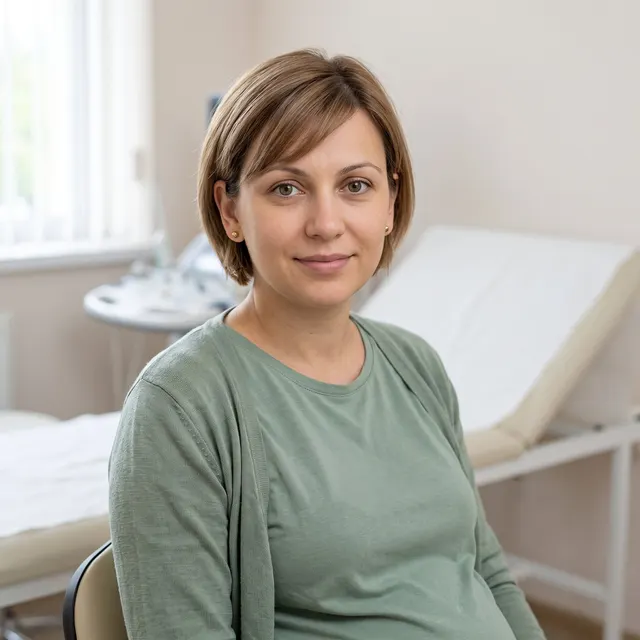
Elena 32, pregnant -
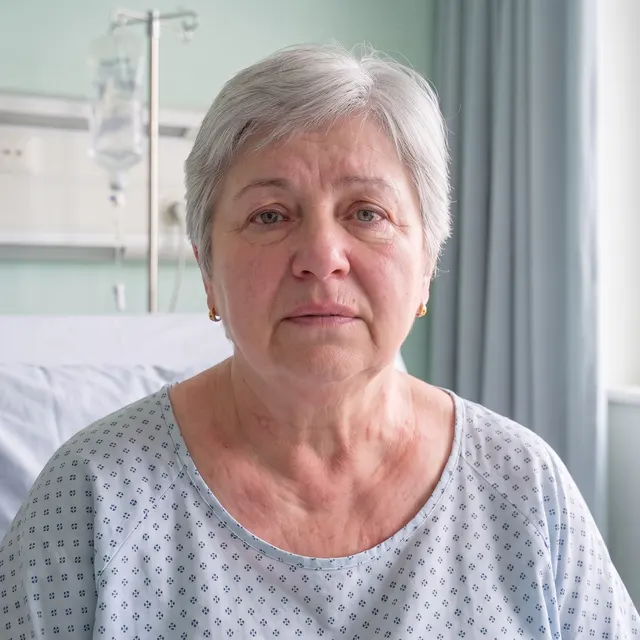
Nadezhda 69, on the ward
Synthetic faces. Example cases.
What you can simulate
From the GP's office to an emergency on the ward.
You get many ready-made cases, and we keep building new ones with physicians. Each case can be graded against European guidelines, a clinical pathway or your department's protocol.
-
Cardiology
- Acute coronary syndrome
- Atrial fibrillation
- Heart failure
- Supraventricular tachycardia
Standard: ESC
-
Emergencies
- Anaphylaxis
- Sepsis
- Pulmonary embolism
Standard: ERC 2025, EAACI, Surviving Sepsis
-
Respiratory
- Asthma attack
- Breathlessness and hypoxia
Standard: GINA 2026
-
General practice
- Headache and high blood pressure
- First visit and referral
Standard: ESC 2024
-
Internal medicine
- Deterioration on the ward
- Orders and follow-up
Standard: Clinical pathway
-
Your cases
- Anything your teachers describe
Standard: Department protocol
Case authoring
Three sentences. A patient who answers.
Describe who the patient is and what the student has to do. About a minute later the draft is ready, and personal details are replaced before anything is processed.
The teacher’s description
[NAME 1], 62, a driver, comes to his GP on [DATE 1] with a tight pain behind the breastbone that began on the stairs this morning. The pain goes to his left arm. He has smoked for thirty years and has high blood pressure he treats irregularly.
Name and date removed.
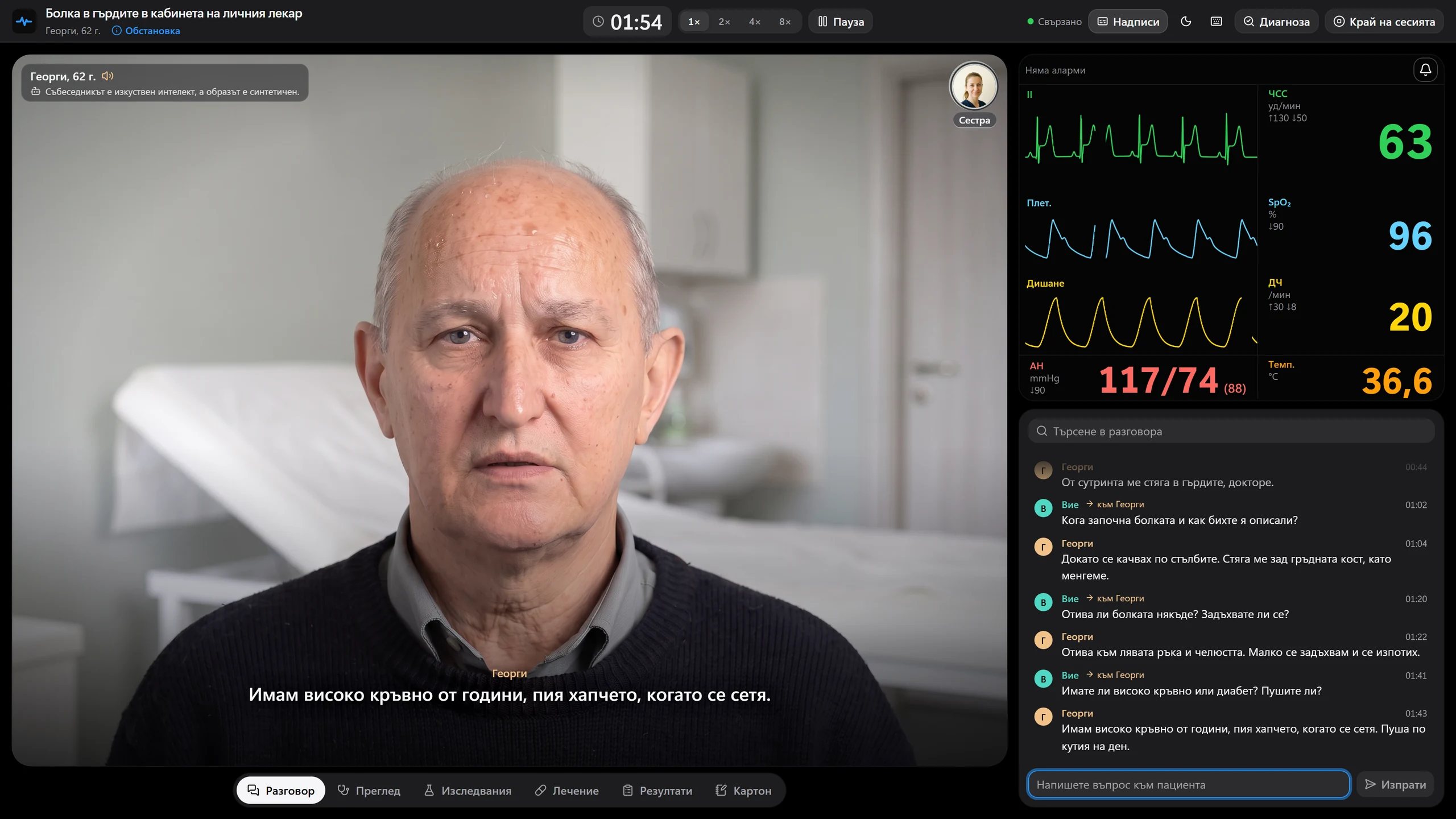
A draft in about a minute
For the student
Talk to the patient. Examine. Treat.
Students ask out loud, listen with a stethoscope and give orders to the nurse. When treatment comes in time, the patient improves. When it comes late, the patient gets worse.
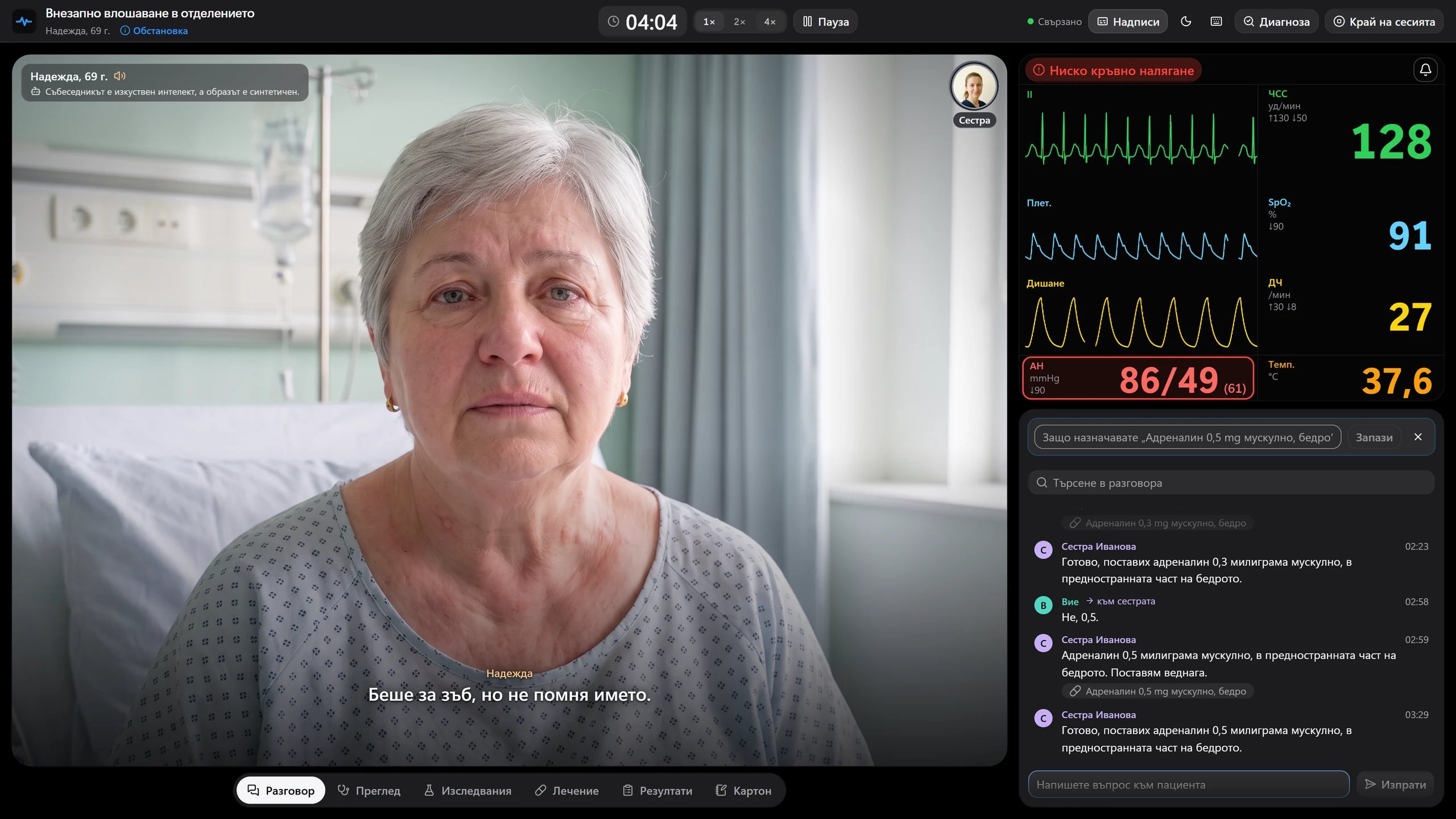

The nurse
- Nurse Ivanova
Adrenaline 0.3 milligrams intramuscularly, into the anterolateral thigh. Giving it now.
- Student
No, 0.5.
- Nurse Ivanova
OK, correcting that. Adrenaline 0.5 milligrams intramuscularly, into the anterolateral thigh. Giving it now.
The patient speaks only from the case. Nothing invented, and never the diagnosis.
When the case says nothing, the answer is “I don’t know.”
The technology
Behind every conversation, seven systems work at once.
Speech, voice and face, clinical rules, a 3D body, the monitor, the nurse and the debrief have to work together while the student is talking. That is why Virtual Patient is hard to build and harder to copy.
- 22auscultation points
- 75investigations with results
- 74drugs with dose checks
- 12monitor rhythms
- 137automatic checks on every case
- 12clinical standards for grading
-
A spoken conversation
Understands medical questions and answers in its own voice in Bulgarian, English, German, French, Spanish, Italian and many more.
-
A face with emotion
Fear, pain and relief are heard in the voice and seen in the face.
-
Clinical rules
Timely treatment and the patient improves. A delay and the condition worsens.
-
Nothing invented
Every sentence is checked before it is spoken. The diagnosis is never given away.
-
A 3D body
Inspection, palpation, percussion and auscultation with recorded sounds.
-
A nurse on the team
Reads back every order and checks the dose, the route and allergies.
-
A debrief by the standard
Every decision on the timeline, with criteria and quotes from the student.
Built for our medicine.
International virtual patient products are built for other health systems and other curricula. Virtual Patient was built in Bulgaria: it follows the European guidelines and Bulgarian clinical pathways, speaks Bulgarian without translation and grades against your department's protocol.
Grading standards
- ERC 2025emergencies and teamwork
- ESCsix guidelines, from ACS to heart failure
- EAACIanaphylaxis
- GINA 2026asthma
- Surviving Sepsis 2026sepsis
- Clinical pathwayto Bulgarian requirements
- Department protocolyour own rules
Figures from the system as of 1 October 2026.
For the teacher
You see everything. The grade is yours.
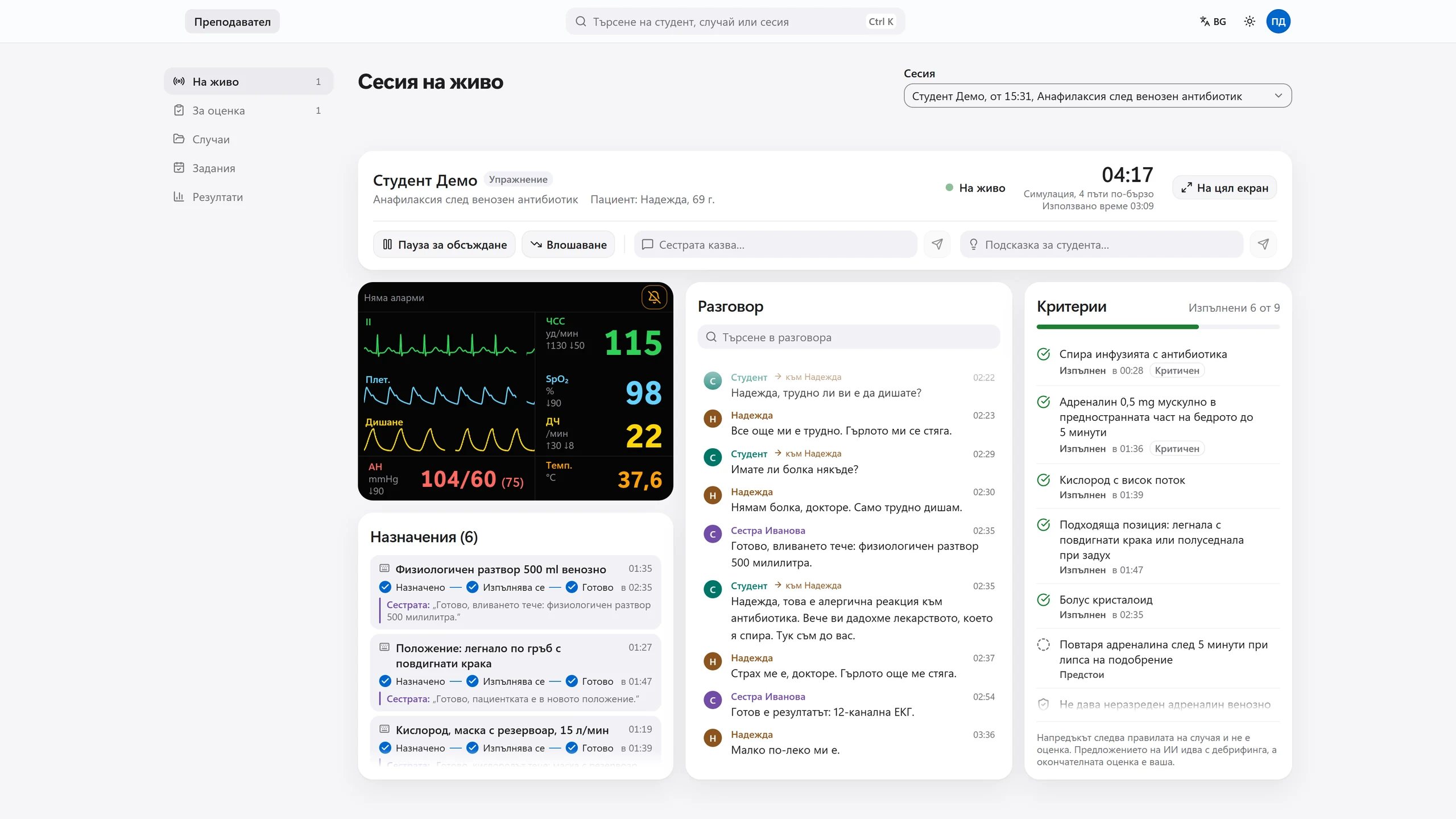
Watch sessions live. Afterwards, every decision sits in its place on the timeline. The system suggests a score, and you confirm or change it.
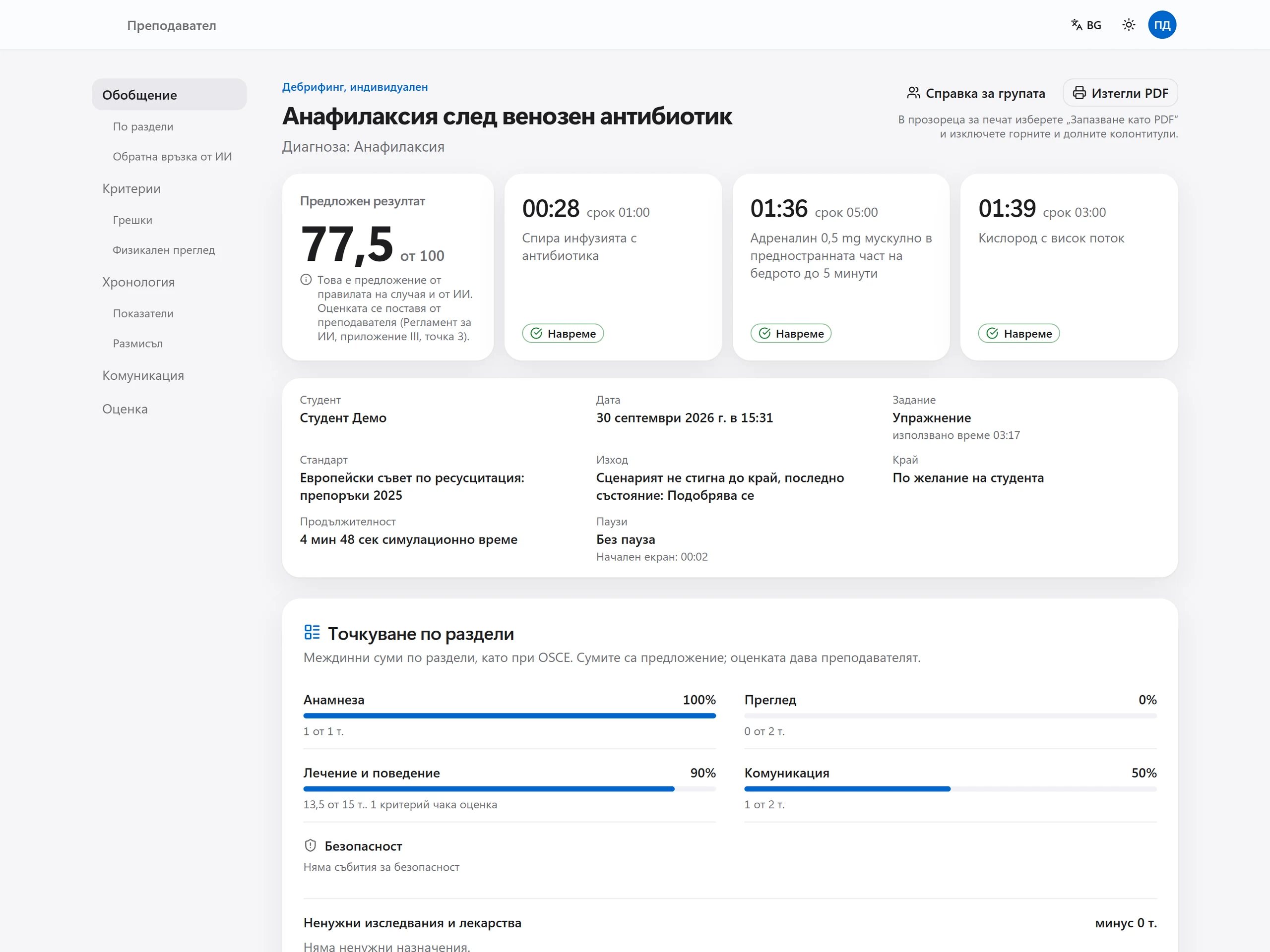
Suggested score
77.5of 100
The system suggests, the teacher decides.
Practice, exam, OSCE
The same case for every kind of assignment.
Live
Step in whenever you choose.
Group report
Ready to print after every class.
Personal data stays with you
Outside services never see students’ names, and no audio is kept.
Transparent
Students know the patient is a simulation and the face is synthetic.
The teacher grades
Regulation (EU) 2024/1689 lists systems that evaluate learning outcomes as high-risk, so the system only suggests.
51 trials
4,696 participants
A meta-analysis compared virtual patients with traditional teaching: skills grew more, and knowledge at least as much.
Kononowicz AA et al. J Med Internet Res. 2019;21(7):e14676. DOI 10.2196/14676, external link
The evidence is of low to moderate quality and concerns the method, not Virtual Patient itself.

About us
Omega Group. Technology for medicine.
Virtual Patient is a product of Omega Group. For years we have delivered digital and engineering solutions to hospitals and medical universities, and we build cases together with physicians and teachers.
ISO 9001 and ISO 14001. Member of DHI Cluster, Bulgaria's digital health cluster.
-
Medical simulation
Virtual and augmented reality training with simulated lab and surgical scenarios, and anatomy labs at medical universities.
-
Artificial intelligence
Medical training systems with adaptive learning paths, and a national drug registry with an evidence-based assistant.
-
Digital healthcare
Hospital information systems, digital laboratories, telemedicine and vital signs monitoring.
-
Education
Systems that manage the training of medical staff and the learning process.
Questions
Questions and answers.
How is this different from a collection of ready-made cases?
Virtual Patient comes with many ready-made cases, and the library keeps growing. Your teachers can also write their own cases to your protocols, and we build new ones with physicians. The system gives every case a voice, a face, a nurse, a monitor and a debrief.
Can the patient make things up or give away the diagnosis?
No. The patient speaks only with the facts of the case, and when something is not written, says “I don’t know” or “I don’t remember.” Every answer is checked before it is spoken.
Can we grade against our own protocol?
Yes. The standard is part of the case: international guidelines, a national clinical pathway or your department’s own protocol. The teacher always sets the grade.
Does it replace manikins and standardised patients?
No. Manikins stay for hands-on skills and actors for real human contact. The virtual patient adds more conversations, more decisions and more repetitions, under the same conditions for every student.
What data is kept, and who sees it?
We keep the text of the conversation and every action with its time, because the debrief is built from them. Audio is not kept, and outside services see a pseudonym instead of the student’s name. The details are in the data processing agreement.
How do we start, and what does it cost?
With a demo. The system is offered per institution: a licence for 3 to 5 years, workstations, an instructor station, a debrief display, cases, training and warranty. Pricing depends on the number of students and the scope. For a quote, request a demo or write to hello@virtualpatient.bg. The supplier is 22 Ventures Ltd.
Bring us one of your cases. We’ll build it in front of you.
In the demo you will see the conversation, the examination, orders and the debrief, and we will talk about where your department could start.
or write to hello@virtualpatient.bg